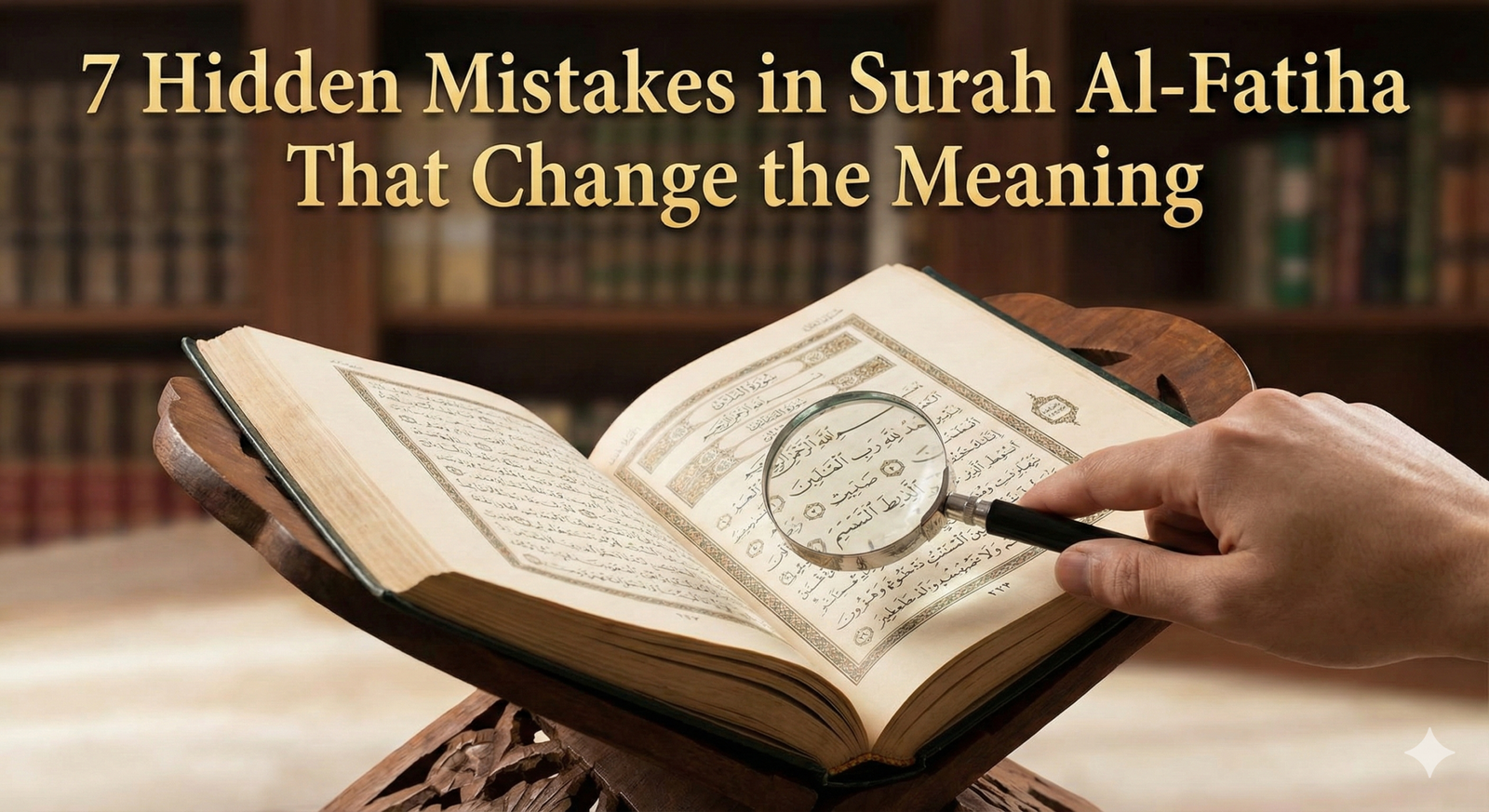
Did you know that changing a single letter in Surah Al-Fatiha can alter the meaning of your prayer?
Surah Al-Fatiha is the heart of the Quran. We recite it at least 17 times a day in our daily prayers (Salah). The Prophet Muhammad (PBUH) said: “There is no prayer for the one who does not recite the Opening of the Book” (Al-Bukhari).
However, for many non-native Arabic speakers, distinguishing between similar sounds is a major challenge. A small slip of the tongue can turn a praise of Allah into a completely different word—sometimes even invalidating the meaning.
Here are 7 common mistakes people make when reciting Al-Fatiha, and how to fix them to ensure your Salah is perfect.
1. Swapping ‘Ha’ (ح) with ‘Ha’ (هـ) in “Al-Hamdu”
This is the most common error.
-
Correct: Al-Hamdu (الحمد) with a sharp ‘H’ from the middle of the throat. Meaning: “All Praise belongs to Allah.”
-
Incorrect: Al-Hamdu (الهمد) with a soft ‘H’ from the chest. Meaning: “Death” or “Extinguish.”
-
The Fix: Squeeze your throat slightly to produce the sharp, raspy ‘Ha’ sound (ح).
2. Dropping the Shaddah in “Iyyaka” (إياك)
The word Iyyaka means “You alone.” It must be pronounced with a stress (Shaddah) on the ‘Y’.
-
Correct: Iyyaka (with strong pressure on the Y). Meaning: “You alone do we worship.”
-
Incorrect: Iyaka (without stress). Meaning: “The light of the sun.”
-
The Fix: Imagine there are two Y’s. Press on the sound to emphasize that worship is for Allah alone.
3. Changing the Vowel in “An’amta” (أنعمتَ)
This is a critical grammar mistake in the verse Sirat alladheena an’amta alayhim.
-
Correct: An’amta (with a ‘Ta’ sound). Meaning: “The path of those YOU (Allah) have blessed.”
-
Incorrect: An’amtu (with a ‘Tu’ sound). Meaning: “The path of those I have blessed.”
-
The Fix: Be very careful with the ending sound. You are addressing Allah, not yourself!
4. Confusing ‘Sad’ (ص) with ‘Seen’ (س) in “Sirat”
-
Correct: Sirat (صراط) requires a heavy, full-mouth sound.
-
Incorrect: Sirat (سراط) sounds like a thin ‘S’, changing the word completely.
-
The Fix: Elevate the back of your tongue when pronouncing the ‘S’ to make it heavy and thick.
5. The “Maghdoobi” Mistake (المغضوب)
Many learners struggle with the letter ‘Ghayn’ (غ).
-
The Mistake: Pronouncing it like a ‘Q’ (Qaf) or a standard ‘G’.
-
The Fix: The sound should come from the top of the throat, similar to a gargling sound. It must flow smoothly without bouncing.
6. Mixing ‘Daad’ (ض) and ‘Dhal’ (د/ظ) in “Al-Dalleen”
The letter ‘Daad’ is unique to the Arabic language (the language of Daad).
-
The Mistake: Pronouncing Walad-Dalleen as Walad-Zalleen or pronouncing a light like Daal letter.
-
The Fix: The side of your tongue must press against the upper molars. It is a heavy, elongated sound, distinct from the ‘Z’ sound.
7. Rushing the Ends of Verses
Often, readers cut off the last letter of a verse or bounce it when they shouldn’t.
-
The Fix: Give every letter its right. Pause gently at the end of each Ayah, as was the Sunnah of the Prophet (PBUH).
How Can You Be Sure Your Fatiha is Correct?
Reading about these mistakes is the first step, but you cannot hear your own pronunciation errors. You need a qualified teacher to listen and correct you.
At Quran Mubeen Academy, our certified Azharian tutors specialize in fixing these hidden mistakes. In just a few sessions, you can master the pronunciation of Surah Al-Fatiha and pray with confidence.